
浪漫刺客
Chinese-made infrared telescope with domestic detectors achieves astronomical imaging, reducing foreign reliance_我的网站

A |
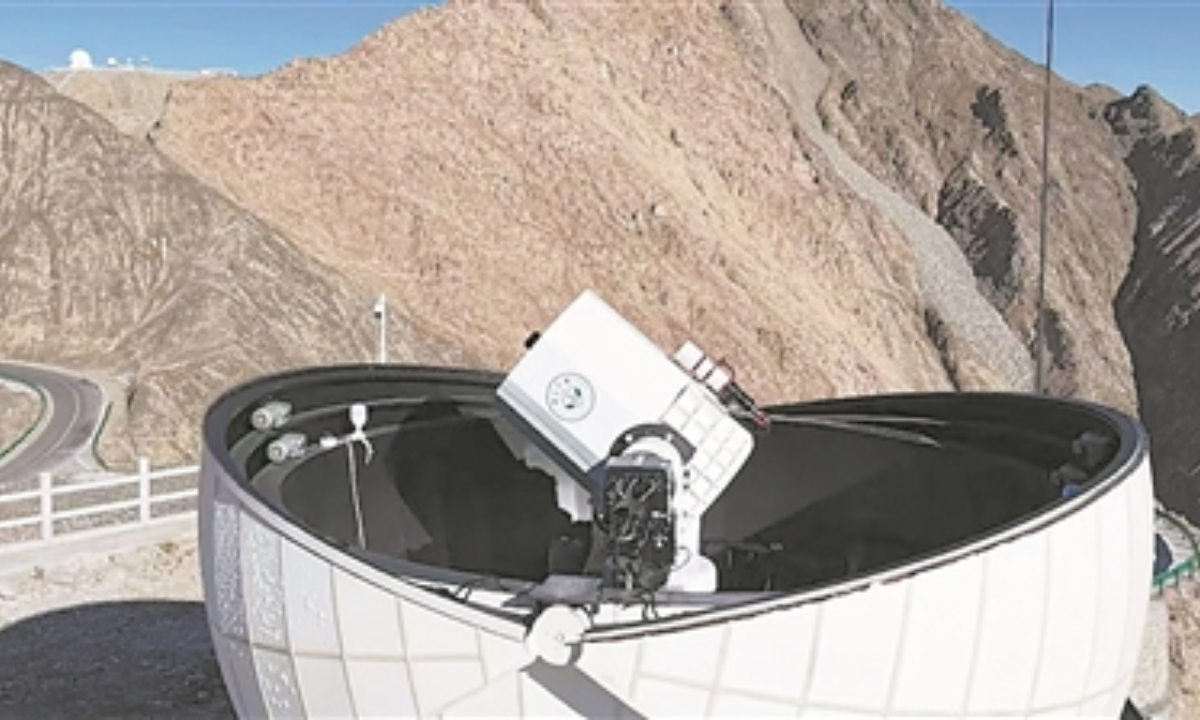
Chinese scientists on Wednesday released the first complete set of observational images captured by China's new-generation ground-based infrared telescope, filling a gap in the country's near-infrared astronomical observation capabilities and reducing reliance on foreign infrared detector technology, China News Service reported on Wednesday.
The 80-centimeter near-infrared telescope was installed at Saishiteng Mountain, Lenghu township, Northwest China's Qinghai Province in October 2024. Jointly developed by Sun Yat-sen University and several partner institutions, the telescope is China's first to achieve scientific imaging in the 1.2-micrometer J band and 2.2-micrometer K band using domestically developed scientific-grade InGaAs and HgCdTe detectors.
The telescope enables unattended remote operations, and can lock onto any target in the sky within 15 seconds. Its infrared capability allows it to see through interstellar dust, enabling it to observe cold and distant celestial objects that are difficult for optical telescopes to capture.
According to Ma Bin, a professor at the School of Physics and Astronomy, Sun Yat-sen University who led the research team that released the infrared telescope's observational images, all three of the telescope's core astronomical observation capabilities were fully validated during operation.
It rapidly responded to and tracked multiple gamma-ray bursts and supernova events, recording the evolution of their infrared afterglows following the explosions. It continuously monitored brown dwarfs, precisely capturing periodic variations in their atmospheric brightness. Using image-stacking technology, it also observed active galaxies billions of light-years away.
Since its deployment in Lenghu, the system has supported infrared observations for more than 10 Chinese research institutions, accumulating valuable experience for the construction of future large-scale infrared telescopes.
Lenghu township, where the world-class astronomical observation base takes shape, is hailed as "the most Mars-like place on the Earth." The astronomical observation base was said to be an astronomical observation site comparable to the top ones in the world by a Nature article published on August 18, 2021, according to the Chinese Academy of Sciences.
Once prospered in 1950s due to its rich petroleum resources, Lenghu is now becoming a premier astronomical observation site and Mars-themed tourist destination, according to Xinhua News Agency.
Global Times
。

B | 每日商报讯 台风过境,本已偃旗息鼓的高温又重振旗鼓,昨天,杭城迎来久违的阳光,主城区跃上35.7℃,高温叠加高湿,有种重回“黄梅天”的错觉。不过,台风残涡并未就此作罢,“尾巴”还将持续洒水。截至昨日19时,杭州市主城区、临平区、临安区等多地发布暴雨黄色预警,余杭区发布暴雨红色预警。为什么明明台风已经停编,却还在大面积“洒水”?市气象台解释,从卫星云图上来看,“白海豚”的残余环流结合了西风槽以及台风的尾流,共同组合成为范围广阔的降水系统。而在天气形势图上,这片降水系统的东边和西边都是高压系统,导致降水系统相对较为稳定。受其影响,杭州在短期之内多雨的天气格局不会改变。值得注意的是,接下来强降雨还可能会杀个“回马枪”。这是因为,“白海豚”的尾流里西南季风和高压底部的东南气流交汇,还将催生出新的低压系统,未来“白海豚”的残余低压缓慢东移,与东边新生低压逐渐靠近,进一步增强杭州上空的辐合上升运动,加上季风源源不断输送水汽,预计今明两天杭州的降雨量将会明显增大,局地可能出现短时强降水、雷雨大风等强对流天气。好在,等这波雨水过去,本周日将迎来降雨暂歇,全省以多云到阴为主,部分有阵雨或雷雨,算是难得的“中场休息”。另外,台风还在扎堆生成,今年第17号台风“浪卡”(热带风暴级;英文名称Nangka;名字来源:马来西亚;名称意义:又名菠萝蜜果,黄色椭圆形状,是马来西亚非常流行的一种水果)于昨天上午在西北太平洋洋面上生成,下午5时许位于距离日本东京东南方向约1510公里的海面上,预计将以每小时30—35公里的速度向东北方向移动,未来“浪卡”对我国无影响。可以说,8月以来台风似乎无间断,如此密集生成是不是有点反常?其实,西北太平洋和南海一年四季都可能有台风生成,7月至9月是台风活跃季,8月台风生成的数量与登陆我国的个数均居于全年首位。8月平均有5.63个台风生成,其中2.3个登陆我国。近期台风密集,总体也符合常年规律,历年8月台风生成数最多的是1960年,多达14个。
Current article:http://6uu.cousizhegaobaolengkuo.bond/list_a0r7/kc2.html
Published on:11:47:56